The Beginning
I was born in Cookstown, County Tyrone in 1869. My mother died before I knew her face. My father followed not long after. What was left was hunger, silence, and a city that cared nothing for orphaned children.
Let me begin with the part of my story that gets glossed over most often — the beginning. Not the typhoid. Not the quarantine. Not the nickname they gave me in the newspapers. My actual beginning: the years before any of that, when I was simply a child trying not to starve in a city that had no particular interest in whether I lived or died.
I was born on September 23, 1869, in Cookstown, County Tyrone — the daughter of Irish parents who had little to give me but life itself. The Mallons were not a prosperous family. Poverty was not a season we passed through; it was the climate we lived in. There was never quite enough. That was the condition of life for families like ours — perpetual insufficiency, softened occasionally by community and faith, but never truly resolved.
My mother died when I was an infant. I have no memory of her — no voice, no face, no warmth. Just an absence that followed me everywhere, a hollow space shaped like a person I would never know. Her name was Catherine. That is almost everything I can tell you about her. She was Irish. She was poor. She died young. The records of women like her were not carefully kept.
Poverty was not just the absence of money. It was the absence of hope, of comfort, of anyone who cared whether you lived or died. I learned that lesson before I was old enough to name it.
My father followed her when I was still very young. I was sent to live with relatives — an aunt and uncle who had already made the crossing to America. They took me in not out of warmth, I think, but out of obligation. I was an extra mouth, an inconvenience, a responsibility they hadn't chosen. I felt that every day.
Arriving in America
I came to America as a child, arriving in New York — likely in the early 1880s, though the exact year is uncertain. The immigration records from that period are incomplete, and the arrivals of poor Irish children did not command great administrative attention. What I remember most of that early period is the scale of everything: the harbor, the noise, the impossible press of bodies in the streets.
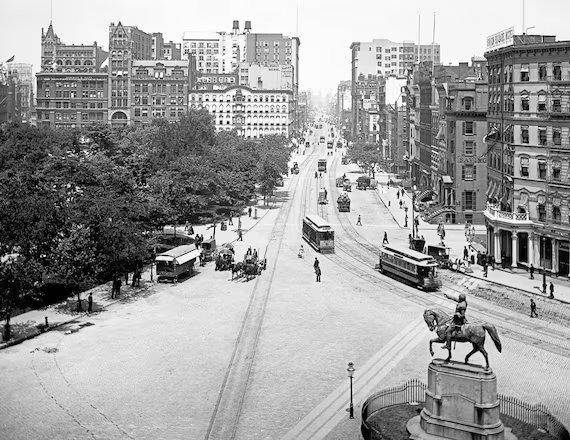
The New York I arrived in was a city of extraordinary contrasts. The wealthy lived in brownstones and attended grand restaurants and theatres. The poor — the vast majority of immigrants like us — lived in tenement buildings, five or six families to a floor, sharing water from a single pump and using outhouses in the alley. Cholera, typhoid, and tuberculosis moved through those buildings with terrible efficiency. Death was not an abstraction. It was a neighbor.
My aunt and uncle's home was not particularly different from the tenements around it. Cold in winter, sweltering in summer, perpetually crowded. I was put to work as soon as I was old enough to be useful. Cleaning. Carrying. Running errands. Whatever needed doing. I don't remember this as cruelty, exactly — it was simply what children in our circumstances did. You contributed or you were a burden, and being a burden was the worst thing you could be.
What Poverty Actually Means
I want to be specific about what poverty meant, because it's too easy to speak of it in abstract terms that don't capture the reality. Poverty meant going to bed hungry more nights than not. It meant wearing the same dress for months, washing it when you could, wearing it dirty when you couldn't. It meant that illness was a catastrophe, because you couldn't afford a doctor and you couldn't afford to stop working.
It meant invisibility. The wealthy families whose streets you walked past, whose garbage you sometimes picked through — they did not see you. You were scenery to them, part of the backdrop of their city. You existed to serve and to stay out of the way. That was your assigned role, and deviating from it was considered impertinence.
I learned early that the world would not be kind to me. So I learned to be strong instead. Not because strength came naturally, but because weakness was a luxury I couldn't afford.
Poverty also meant certain kinds of knowledge. You learned to read people quickly — who would give you work, who would cheat you, who would pretend not to see you when you needed help. You learned that the law was not a protection for people like you. It was a mechanism of control. Something that happened to you, not something that worked on your behalf.
The Irish in New York
Being Irish in New York in the 1870s and 1880s carried its own particular weight. The Irish were considered the lowest rung of the social ladder, frequently described in newspapers and popular culture using terms of contempt. We were considered dirty, violent, prone to drink and disorder. Respectable society treated Irish immigrants as a threat to civic order and American prosperity.
This wasn't merely social discomfort. It had material consequences. Irish immigrants were restricted to the lowest-paying, most physically dangerous jobs. Domestic service, construction, factory work. Women like me became cooks, laundresses, seamstresses, housemaids — invisible workers maintaining the households of people who would never learn our last names. We were "Mary" or "Bridget" or "Nora," interchangeable, disposable.
I want you to understand this context when you think about my story. When I was eventually identified as a typhoid carrier and quarantined without trial, I was not simply an unlucky woman caught in unusual medical circumstances. I was an Irish immigrant woman at the bottom of the social hierarchy, with no money, no political connections, no family with influence, and no legal representation. I was exactly the kind of person who could be made to disappear without anyone in power losing sleep over it.
Learning to Survive
By my early teens, I had learned the essential survival skills of my class and position. I was quick. I was reliable. I could follow instructions without needing them repeated. I understood that my value to any employer was entirely contingent on my usefulness, and I worked to make myself indispensable. These weren't virtues in any elevated sense — they were strategies for survival, no different from any creature that adapts to hostile conditions.
I found my way into kitchens at around fourteen. First in a minor capacity — scrubbing pots, peeling vegetables, hauling coal for the ovens. The work was brutally hard and the pay was almost nothing, but kitchens were warm and there was always food nearby, which mattered more than I can explain to anyone who has never been truly hungry.
Something happened to me in those kitchens that I didn't have words for at the time. I was good at it. Not just adequate — genuinely, noticeably skilled. I had a natural instinct for flavors and temperatures and timing. I could look at a kitchen and understand its logic. I could learn a dish from watching it made once. The older cooks I worked under noticed, and some of them took the time to teach me properly.
What I Carried Forward
I carry the memory of those early years with me as both wound and armor. They made me capable of endurance that I think surprised even the people who eventually tried to break me. Decades of isolation, poverty, and public humiliation — none of it destroyed me, and I believe it's because I had already survived the foundational training of my childhood. I knew how to go on when there was no visible reason to go on.
Those years also made me suspicious of authority in ways that would later be used against me. I had learned, through direct experience, that powerful institutions — government, law, medicine — did not operate in the interest of people like me. When officials came to tell me what I must do, what I must submit to, what I must sacrifice for the public good, I didn't hear responsible governance. I heard the familiar language of coercion dressed in professional clothing.
I didn't become difficult because I was born difficult. I became careful because the world had taught me, systematically and thoroughly, that I needed to be.
My childhood gave me nothing materially. No inheritance, no education, no family connections, no financial security. But it gave me something else — a knowledge of my own capacity to endure. And in the end, that was the thing they could never take from me, no matter how long they kept me on that island.